
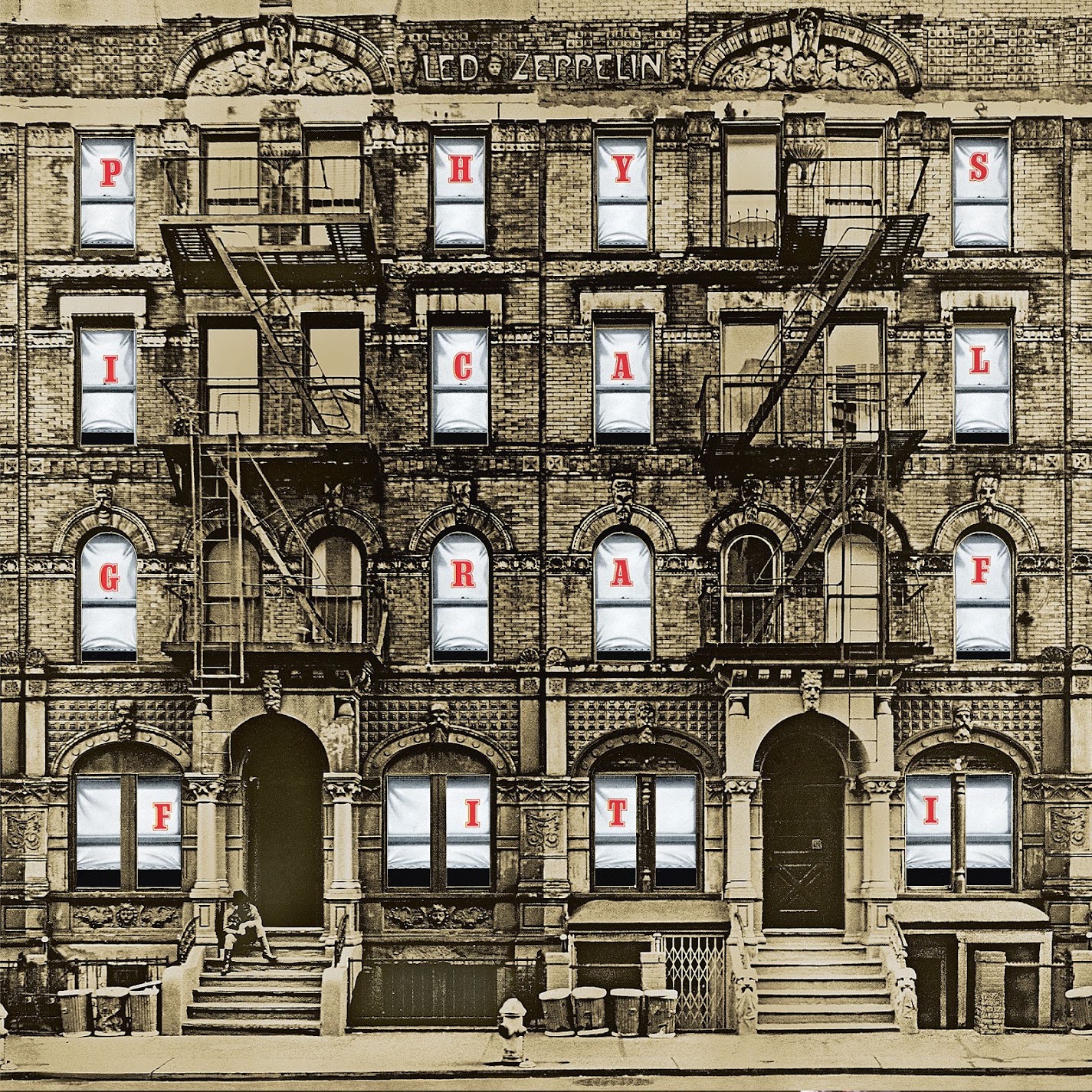
Physical Graffiti
Jimmy Page
I was particularly keen to make Physical Graffiti, because it was going to be a good way to use material left over from the recordings of the fourth album — songs like ‘Down by the Seaside’, ‘Boogie with Stu’ and ‘Night Flight’. We also had ‘Houses of the Holy’ left over from the fifth album. I thought that it would be novel to leave the title track off one album and then put it on the next.
A
-
1Custard Pie4:15
‘Custard Pie’ was one of those riffs and changes I had worked on at home before we had initially come together at Headley. I had always intended for a harp solo to be in the middle of that and Robert excelled himself on that as an overdub. It was intended to be a driving guitar riff around a Blues theme and it was great fun to play. The original working title was ‘Drop Down Mama’. -
2The Rover5:39
‘The Rover’ was initially done at Mick Jagger’s place, Stargroves, with Eddie Kramer engineering, but then we added some overdubs in the mobile truck with Ron Nevison at Headley. The main riff and track were done at Stargroves and it sounded really mighty and powerful. The solo guitar parts went on later at Olympic with Keith Harwood during the overdub and mixing sessions. -
3In My Time of Dying11:08
‘In My Time of Dying’ is an extraordinary piece of work, and it’s just a one-take live performance. It goes to show just how exciting we were live. The end part was generated by nods and winks as we’d never actually rehearsed how to finish the song, but after improvising around the theme we did arrive at an ending on that one take. I actually overdubbed the guitar in the solo parts at a later date because I didn’t think the original pass was good enough for the solo that was done in the one take, and I thought I could do better. On the re-release with the companion disc I just used the original first mix because actually it wasn’t too bad at all.
B
-
4House of the Holy4:04
The original track for ‘Houses of the Holy’ was recorded by George Chkiantz who also recorded ‘Whole Lotta Love’ at Olympic Studios. I mixed this at Electric Ladyland studios with E Kramer. There was an interesting digital feedback effect that was applied to the guitar solo that appeared at the end of the song that added a spatial dimension. ‘Houses of the Holy’ was left over from the fifth album. I thought that it would be novel to leave the title track off one album and then put it on the next. Just to keep people guessing, and as a link between the two albums. -
5Trampled Under Foot5:36
John Paul Jones had a Stevie Wonder-type vamp that he was playing on the keyboard at Headley Grange, working title ‘Brandy & Coke’, that was added to and expanded until it actually arrived at ‘Trampled Underfoot’. There were some unusual backwards echo guitar overdubs that were done later at Olympic Studios with Keith Harwood, who did the mixdown with me. -
6Kashmir8:37
‘Kashmir’ was a riff and concept that I had discovered and worked on in my home studio at Plumpton in advance of the planned recordings at Headley Grange in October 1973. As things worked out, I managed to run over this and routine this with John Bonham. I remember we played the riff repetitively: over and over and over. It was mantric and after laying down a track of it I was able to start illustrating to John Bonham the way that I envisaged it by overdubbing the cascading chords that are replicated with brass instruments on the final recording. So there were four of us that first experienced the overdub playback in the recording truck and nobody really said a word, our expressions said it all but we all knew! Those who witnessed it were Jimmy Page (guitars), John Bonham (drums), Ron Nevison (engineer) and Brian Conliffe (assistant engineer).
C
-
7In the Light8:47
When we were all assembled, John Paul Jones started playing the keyboard at Headley Grange. As we joined in, the working title was ‘Everybody Makes It Through’. I had wanted to apply a bowed guitar drone to an introduction underneath what was later to become a dazzling synthesizer overdub played by John Paul Jones. The song develops through to a chorus with the lyric ‘In The Light’ with a repeating ascending underlying guitar figure. Robert finessed the lyrics of the verses and later on overdubbed an incredible block singing technique that reminded me of the music of Bulgaria. I think Robert’s lyrics throughout this song were outstanding. -
8Bron-Yr-Aur2:06
‘Bron-Yr-Aur’ is an instrumental I wrote that resurfaced from Bron-Yr-Aur cottage in Wales in 1970. I processed the guitar much later during the recording and mixing process with a variety of effects to make it sound like it was more orchestral than one guitar playing. It’s really effective. And it worked very well in the film ‘The Song Remains the Same’ as the soundtrack to a New York street scene. It was recorded at Island Studios in 1970 and then it was retrieved from the vaults and further work was done applying effects at Olympic Studios with Keith Harwood in October 1974 where it was also mixed. -
9Down by the Seaside5:15
‘Down By The Seaside’ was recorded around the time of the fourth album, at Island Studios, with Andrew Johns. This is very much Robert’s song. Mixdown was by Keith Harwood at Olympic Studios. -
10Ten Years Gone6:34
‘Ten Years Gone’ was something I had constructed at my home studio at Plumpton. I had the facilities to be able to record on an eight-track Studer analogue tape machine. I worked out all of the sections of this song including their appropriate overdubs, there were multiple guitar orchestrations and I even played bass on my home demo. To have the demo in such a form was very useful to illustrate the overall concept and the various moods and different sections of the song. At Headley, I played it to the band and said I really wanted to do this note-for-note the way I had crafted it at home. We did and Robert wrote some lyrics that connected to the music admirably.
D
-
11Night Flight3:38
‘Night Flight’ begins with keyboard and electric twelve-string and it’s an opening riff that’s played which very quickly develops into a sequence for a song. It was a live recording with the vocal. We had some fun on that song. -
12The Wanton Song4:08
This is one of my homemade concoctions with the sequence complete when it arrived at Headley Grange. It really came to life with the members of the band and the ambience of Headley, particularly the drums, and everyone gelled remarkably on this one. There were later guitar overdubs with Keith Harwood at Olympic Studios. -
13Boogie with Stu3:52
During the initial recordings for Led Zeppelin IV, we had hired the Rolling Stones’ mobile recording studio to be at Headley Grange. One day, we were all playing in what was, at the time, the lounge. In it there was a baby grand piano that had been deemed unplayable by John Paul Jones. And having tried a few chords myself I seconded that opinion. We just so happened to be running through something or other when the lounge door opened and in came Ian Stewart, who was connected to the Rolling Stones mobile studio and he was connected to the Stones’ records with his piano playing. He ambled over to the piano and started rolling his fingers and hands and bringing this piano to life with some amazing rolling blues. The unplayable piano was conquered by Stu. We stopped what we were doing and ended up doing a song which featured him, which was simply called ‘Boogie With Stu’. John Paul Jones and John Bonham were outside the lounge in the famous hall clapping and foot-stomping and enjoying the ambience. I played the acoustic, Robert sang and I overdubbed a mandolin. Records aren’t made like this anymore! -
14Black Country Woman4:24
‘Black Country Woman’ had originally been premiered electrically at a rehearsal at The Lyceum in London with no title. We eventually made a recording of it at Stargroves, Mick Jagger’s country home, with the Rolling Stones mobile recording truck with E Kramer engineering. Robert and I sat on stools in the garden: I was on my acoustic and played in a G open tuning; he sang and played harmonica. At the beginning of this take, a plane flies over and it’s agreed to leave the sound of the plane at the beginning of the song. Another item of note, is that as the song progresses, John Bonham begins to play the bass drum which is in a small conservatory in the house with all these wonderful reflective surfaces, and when he comes in with the full kit, it’s wake up time for anyone having a nap! -
15Sick Again4:42
This is a riff and complete sequence that I put together in my Plumpton studio and I had made a complete guitar demo with numerous overdubs. It was one of the examples that I played to John Bonham when we were on our own at Headley Grange in October 1973 and there’s a particular set of riffs in it that I had written with his drumming in mind. We played it together, he loved it and it really worked well.
Info
A double album released 24 February 1975 on the band’s own Swan Song label, pulling together material from multiple recording periods. Recorded at Island, Headley Grange, Olympic and Stargroves.